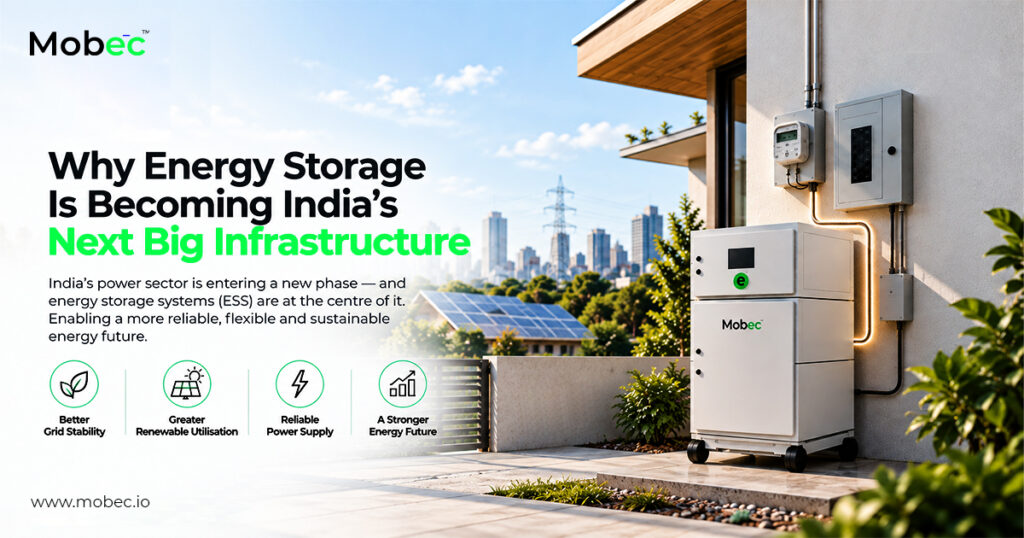
Energy Storage Systems (ESS) are rapidly becoming a key component of modern energy infrastructure, for homes, businesses, communities, renewable power systems, and electric mobility. Understanding ESS is essential in 2026 and beyond, as the energy landscape shifts toward reliability, sustainability, and cleaner sources.
An Energy Storage System (ESS) stores electricity when supply exceeds demand and releases it when demand rises. This makes ESS a bridge between today’s grid and the renewable-heavy future.
Why ESS Matters Today
Renewable sources like solar and wind are growing rapidly, but they are intermittent, the sun doesn’t shine at night and the wind doesn’t blow constantly. ESS addresses this challenge by storing excess energy and dispatching it when needed, ensuring reliable power at all times.
Energy storage also:
- Stabilizes the grid by balancing fluctuations and reducing blackouts.
- Lowers energy costs by storing power during off-peak hours and using it when prices are higher.
- Supports EV charging infrastructure, enabling clean mobility.
Mobec’s energy storage solutions are designed to address all of these needs, whether for residential backup, commercial applications, or EV charging, ensuring smooth energy flow and reduced dependency on the grid.
Types of ESS
Energy storage comes in several forms, but the most widely used is Battery Energy Storage Systems (BESS). Other types include mechanical storage, like pumped hydro, and thermal storage, which stores heat or cold.
Mobec specializes in lithium-ion BESS, providing scalable and safe energy storage for homes, commercial buildings, and EV charging infrastructure. Additionally, Mobec’s second-life battery solutions give used batteries a new purpose in ESS setups, reducing costs and minimizing e-waste.
Top Benefits of Adopting ESS
1. Reliable Backup Power
ESS automatically provides power during outages. Mobec’s systems ensure uninterrupted electricity in both residential and commercial settings.
2. Renewable Energy Integration
Solar energy stored during the day becomes usable at night. Mobec’s BESS integrates seamlessly with solar panels to maximize renewable energy usage.
3. Cost Efficiency
By storing energy when it’s cheaper and using it during peak hours, electricity costs can be reduced. Mobec’s solutions optimize energy usage for maximum savings.
4. Environmental Impact
ESS supports clean energy adoption and reduces reliance on fossil fuels. Mobec strengthens this impact through battery reuse, refurbishment, and recycling.
Latest Policies Shaping ESS Adoption (Budget 2026)
Budget 2026 includes policies that make ESS adoption more feasible and cost-effective:
- Customs Duty Relief on Battery & Storage Equipment
The budget extends basic customs duty (BCD) exemptions on the import of capital goods used for lithium-ion cell production for Battery Energy Storage Systems (BESS). This reduces upfront costs for storage manufacturing and encourages domestic deployment, aligning with Mobec’s mission to expand access to reliable ESS solutions. - Solar Manufacturing Boosts
The government removed the 7.5% BCD on sodium antimonate used in solar glass manufacturing, making solar-plus-storage systems more affordable. Total allocations for solar projects under central schemes rise to ₹30,539.36 crore for FY27, including:
- ₹1,775 cr for grid-connected large-scale solar projects
- ₹5,000 cr for the PM-KUSUM scheme
- ₹22,000 cr for the PM Surya Ghar rooftop programme
- Grid-Scale Storage Support
Policy measures supporting larger-scale energy storage and critical minerals processing create a favorable environment for commercial and industrial BESS integration.
These initiatives collectively lower costs, improve supply visibility, and strengthen domestic ESS manufacturing, complementing Mobec’s role in building a resilient clean energy ecosystem.
Key Considerations Before Adopting ESS
When planning ESS installation, consider:
- Energy Requirements: Backup, peak-shaving, or 24/7 clean energy
- Capacity: How much energy needs to be stored and for how long
- Integration: Compatibility with solar panels or renewable sources
- Safety & Compliance: Meeting local regulations and safety standards
- Lifecycle Planning: Battery reuse, second-life applications, and recycling
Mobec addresses these needs through smart BESS design, second-life battery solutions, and complete lifecycle management, delivering long-term reliability while reducing environmental impact.
Looking Ahead
ESS adoption is set to grow rapidly as renewable energy expands and battery costs continue to fall. Mobec is at the center of this transformation, providing BESS, second-life battery solutions, and integrated storage systems that enable reliable power, sustainable energy use, and circular battery management.
Mobec addresses these needs through smart BESS design, second-life battery solutions, and lifecycle management, brought to life through smart solutions like NewGen 10 and Mobec Homez ESS.
NewGen 10 – Smart charging made simple
- 10 kWh input | 220V output
- Dual sockets (16A & 32A)
- 90% efficient, EV-ready
- Live SOC display with alerts
- Built-in safety & smart control
- Best for homes, events, sites, and mobile setups
Mobec Homez ESS – Smart energy storage for every home
- 8 kW output | 29 kWh capacity
- Instant backup (10 ms switchover)
- Solar, grid & off-grid compatible
- Runs essentials & heavy appliances
- IP54-rated, all-weather design
- Best for homes, offices, and outages