Power needs are becoming more mobile, but traditional generators have largely stayed the same.
They still come with fuel, noise, vibration and regular maintenance. For a fixed location, that may be manageable. But for businesses and teams that move from one site to another, it can quickly become inconvenient.
Construction projects often begin before a permanent power connection is available. Events need electricity only for a few hours. Roadside businesses, mobile clinics, pop-up stores and temporary offices need reliable power wherever they are set up.
In such situations, backup power cannot remain tied to a heavy, fuel-dependent machine.
This is where portable battery generators are becoming increasingly relevant in India. They store electricity and supply it when needed, offering a more flexible way to support temporary, mobile and off-grid operations.
Power No Longer Stays in One Place
Think about how many businesses now operate outside traditional buildings.
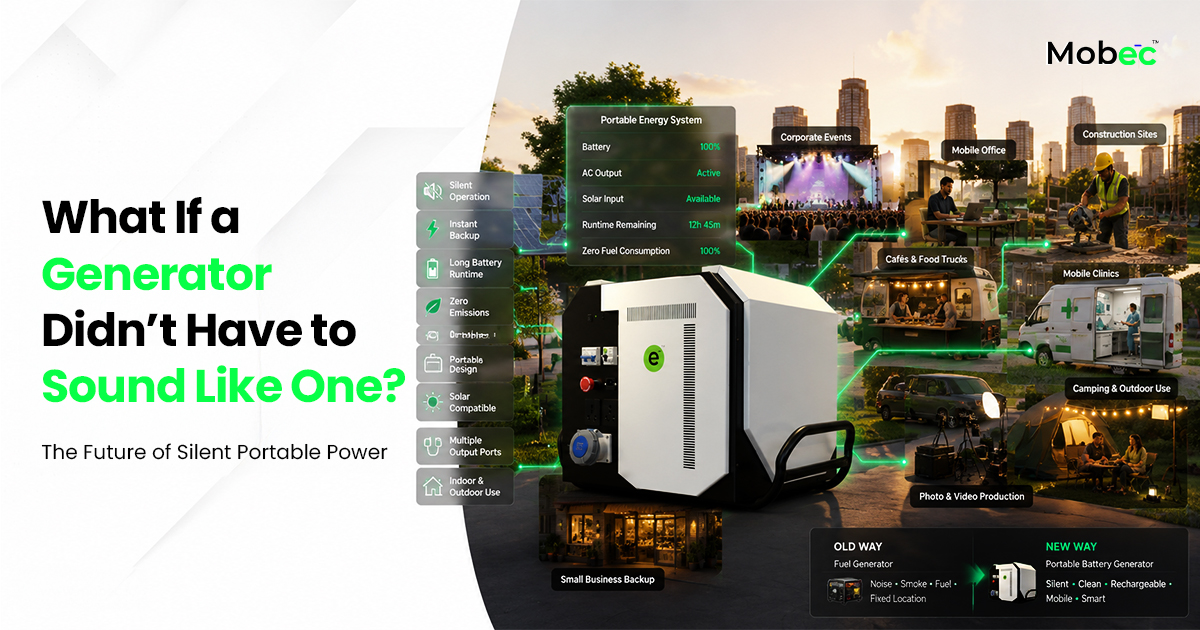
A food stall needs lighting and payment systems after sunset. An outdoor event needs electricity without adding constant engine noise to the venue. A construction team may need to run essential equipment at a site where the permanent connection is still weeks away.
Across India, particularly in fast-moving commercial regions such as Delhi NCR, Noida and Gurugram, work frequently happens in temporary, changing or infrastructure-limited environments.
The problem is not always a complete lack of electricity. Sometimes, the available connection is too far away. Sometimes, the power requirement is temporary. At other times, an outage brings an otherwise functional operation to a sudden stop.
In each case, the real need is the same: electricity that can reach the work, instead of forcing the work to remain close to electricity.
Portable Power Has Outgrown Camping
Mention portable battery power and many people still imagine a small box used to charge phones during a camping trip.
That image is quickly becoming outdated.
Commercial portable power systems are being built to support more serious operational requirements. Businesses now evaluate battery capacity, maximum output, socket options, charging time, safety protections and ease of deployment.
There is also an important difference between capacity and output.
Battery capacity tells you how much energy the system can store. Output tells you how much power it can deliver at a particular time. A system may hold a large amount of energy, but it must also provide enough output to run the connected equipment.
This is why choosing a portable power generator requires more than looking for the biggest number on a specification sheet. It requires understanding what needs to be powered, for how long and in what environment.
Meet Mobec NEWGEN 10
Mobec NEWGEN 10 has been developed for this new category of mobile power.
It combines a 10.8 kWh battery with up to 10 kW output and 220V AC power. Three output ports, including 16A and 32A socket options, allow it to support a range of commercial and field applications.
In this portable power generator, The battery state-of-charge display shows how much stored power remains, helping users plan their operations instead of guessing when the supply may run out.
Built-in safeguards provide protection against overvoltage, undervoltage, overload, temperature, leakage and lightning-related risks. This portable power generator also operates at up to 90 percent efficiency, helping it deliver stored energy with minimal loss.
More importantly, it provides quiet power without requiring a fuel engine to run continuously nearby.
That matters at an event where guests should hear the music, not the generator. It matters at a roadside business serving customers after dark. It matters at a temporary office where people need to communicate, concentrate and keep digital systems running.
Built Around the Workday
Mobec NEWGEN 10 can be considered for construction sites, outdoor events, pop-up businesses, temporary workspaces, field-service operations and emergency commercial backup.
The generator’s actual backup duration will depend on the total connected load, so every deployment should begin with a clear assessment of the equipment it needs to power.
But the larger idea is simple.
A useful power solution should not force a business to reorganise its work around a machine. It should fit into the operation, provide the required electricity and allow everything else to continue.
That is the real promise of a portable power generator. It is not simply backup power stored inside a different box. It represents a more flexible way to think about where electricity can be used.
Portable power is entering a new phase, built around quieter operation, easier deployment and the flexibility to keep work moving across different environments.
Explore Mobec NEWGEN 10 at www.mobec.io.