


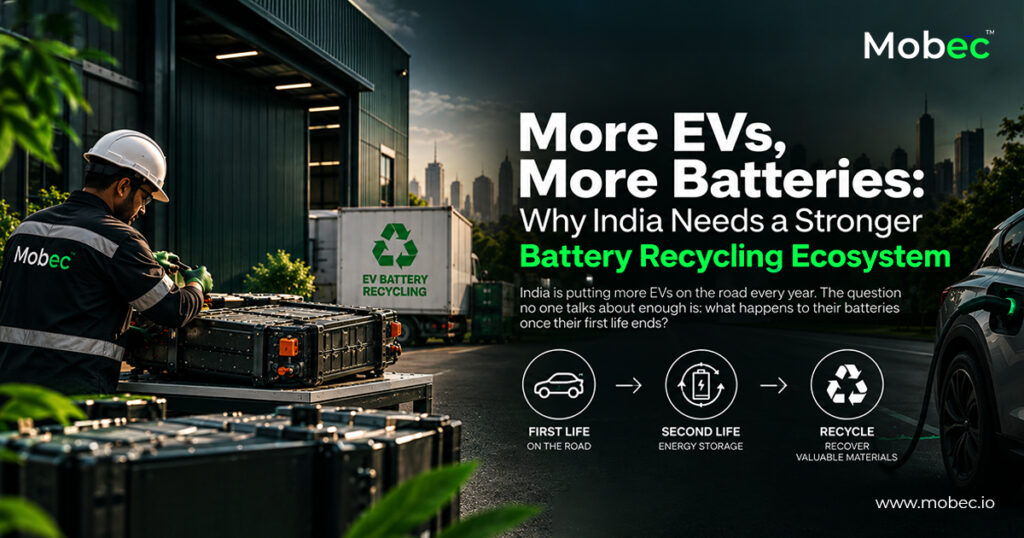
An EV battery can stop powering a vehicle long before the materials inside it run out of value.
Lithium, graphite, copper, aluminium and other materials do not disappear when a battery retires. But recovering them depends on what happens next. Is the battery stored safely? Is it sent through a formal recycling channel? Can its movement and processing be documented?
For automobile manufacturers, battery producers, fleet operators, electronics companies and energy-storage businesses, these are not simply environmental questions. They affect compliance, workplace safety, asset accountability and access to secondary raw materials.
The short answer
Old EV batteries in India should move through a formal system of collection, safe transportation, inspection, recycling and material recovery. They should not remain in warehouses indefinitely or enter untracked scrap channels.
At Mobec, end-of-life lithium-ion batteries are not simply collected and passed on. Mobec processes and recycles them, giving the batteries and the materials inside them a clear and responsible route forward.
Why Lithium Battery Recycling Matters in India
India’s EV, electronics and energy-storage markets are growing quickly, and battery demand is rising with them.
According to NITI Aayog’s 2026 circular economy report, India’s lithium-ion battery demand is projected to increase from 16 GWh in 2023 to 248 GWh by 2035. The same report estimates that end-of-life lithium-ion battery availability could rise from 19 kilotonnes in 2023 to 233 kilotonnes by 2035.
These are projections, not guaranteed outcomes. However, they point towards a clear reality: more batteries entering use today will eventually create a much larger stream of batteries requiring responsible end-of-life management.
India’s policy direction reflects the same concern. In April 2026, the Ministry of Mines announced that 58 companies had been declared eligible under the ₹1,500 crore Incentive Scheme for Promotion of Critical Mineral Recycling. Together, these entities pledged around 850 KTPA of recycling capacity and approximately ₹5,000 crore in investment.
It is important to note that these figures represent pledged capacity and investment. They do not mean that the entire capacity is already operational. Project execution and the commencement of production form the next stage of the scheme.
Even with that distinction, the message is significant. Battery waste is no longer being viewed only as a disposal problem. It is increasingly being recognised as a source of critical materials already present within the Indian economy.
Does Every Old EV Battery Go Straight to Recycling?
Not necessarily.
Reaching the end of service in an electric vehicle does not always mean that a battery has no remaining use. Depending on its condition, safety and residual capacity, a battery may first be evaluated for refurbishment or a second-life application, such as stationary energy storage.
If the battery is damaged, severely degraded or unsuitable for further use, recycling becomes the responsible next step.
This assessment matters because batteries differ in their chemistry, design, age and usage history. A battery should not be repurposed simply because it can still hold some charge. It needs to be inspected and tested before a suitable end-of-life route is selected.
Whether a battery is reused or recycled, it should move through a documented and controlled system.
Battery Recycling Begins Before the Battery Reaches the Plant
The first stage of lithium-ion battery recycling is not shredding. It is responsible collection.
Even after being removed from a vehicle or energy-storage system, a lithium-ion battery may retain electrical charge. If it is swollen, punctured, leaking or thermally damaged, it can create additional risks during storage and transportation.
Businesses therefore need a process for identifying, isolating, documenting and moving end-of-life batteries safely.
Useful information may include:
- Battery manufacturer and model
- Battery chemistry, where known
- Pack or module configuration
- Previous application
- Physical condition
- Available service history
- Signs of damage or thermal stress
This information helps determine how the battery should be handled, transported and processed. It also creates greater traceability for internal audits and regulatory reporting.
What Do India’s Battery Waste Rules Require?
India’s Battery Waste Management Rules, 2022 apply to different types of batteries, including electric-vehicle, portable, automotive and industrial batteries.
The Rules introduced an Extended Producer Responsibility framework under which battery producers, including importers, are responsible for meeting prescribed collection, recycling or refurbishment obligations.
The framework includes:
- Registration of producers and recyclers
- Extended Producer Responsibility targets
- Recycling and refurbishment certificates
- Reporting through the centralised EPR portal
- Use of formal battery-waste channels
- Obligations relating to recycled materials
For businesses, this means that informal disposal is not a reliable battery-waste strategy. A battery leaving a company’s premises should not mean that visibility over it ends. Formal processing and reliable documentation are essential parts of responsible battery management.
What Happens During Lithium-Ion Battery Recycling?
When an old EV battery reaches a recycling facility, it does not immediately go into a shredder. Its condition, construction and chemistry must first be understood.
1. Inspection and safe handling
The battery is examined for swelling, leakage, impact damage or signs of thermal stress. Its remaining charge is assessed, and controlled discharge may be required before further processing.
This stage helps protect workers and equipment during dismantling and mechanical processing.
2. Sorting and dismantling
An EV battery pack contains more than battery cells. It can include:
- Metal casing
- Wiring and busbars
- Cooling components
- Sensors
- Electronic controls
- Structural supports
- Individual modules and cells
Dismantling separates the battery pack into manageable components. The exact process can vary considerably because pack designs differ across manufacturers and vehicle models.
3. Mechanical processing
After the appropriate preparation, the battery cells and components undergo mechanical processing. Depending on the recycling system, this may involve shredding, crushing, screening and physical separation.
These processes help separate material streams such as:
- Aluminium
- Copper
- Steel
- Plastics
- Electrode material
Copper, aluminium and steel can be separated for further processing. The electrode material usually forms a fine, dark mixture known as black mass.
What Is Black Mass in Battery Recycling?
Black mass is an intermediate material produced during the mechanical processing of lithium-ion batteries. It contains portions of the battery’s cathode and anode materials.
Its composition depends on the original battery chemistry.
For example:
- NMC batteries may contain lithium, nickel, manganese, cobalt and graphite.
- LFP batteries generally do not contain nickel or cobalt in the cathode but may contain lithium, iron, phosphate and graphite.
- Battery packs across different chemistries can also provide recoverable copper, aluminium and steel.
This distinction matters because not every lithium-ion battery contains the same minerals or offers the same recovery value. The chemistry, condition and volume of the incoming batteries influence processing requirements and recycling economics.
Is Black Mass the Final Recycled Product?
No. Black mass is an important output of mechanical processing, but it is not automatically a battery-grade material.
Further processing is required to separate and recover individual materials. Depending on the facility, battery chemistry and intended outputs, recyclers may use different technologies.
Hydrometallurgical recycling uses controlled chemical processes to dissolve and separate selected materials.
Pyrometallurgical recycling uses high-temperature treatment to recover certain metals.
Direct recycling is an emerging approach that aims to retain or restore parts of the cathode material instead of breaking every component down into its basic chemical form.
Each method has its own advantages, limitations and operating requirements. The appropriate route depends on the feedstock, chemistry, recovery objective, environmental controls and required output quality.
Recovered materials must meet specific standards of purity, composition and consistency before they can be considered for battery manufacturing or other industrial applications. Producing black mass is therefore an important stage, but material recovery and refining are what move the recycling process closer to circularity.
Why Recycling Is Part of the Battery Supply Chain
Battery recycling is often treated as the last task in a battery’s life. For businesses, it is more useful to view it as part of the supply chain itself.
How a battery is collected, transported, processed and documented determines whether its materials remain in circulation or are lost.
A well-managed lithium battery recycling system can help businesses:
- Reduce the loss of recoverable materials
- Support EPR and battery-waste compliance
- Maintain visibility over end-of-life battery assets
- Reduce risks associated with unplanned storage
- Improve documentation for audits and sustainability reporting
- Support the development of domestic secondary-material sources
Recycling will not replace mining overnight or completely remove India’s dependence on imported battery materials. Its contribution will depend on collection efficiency, battery chemistry, refining capability, end-of-life battery availability and demand for recovered outputs.
However, every battery recycled responsibly creates an opportunity to retain part of its material value within the economy.
How Mobec Recycles End-of-Life Lithium-Ion Batteries
Mobec is not merely a collection partner connecting businesses with an external recycling process. Mobec carries out lithium-ion battery recycling itself.
Through its battery recycling operations in Noida, Uttar Pradesh, Mobec manages end-of-life batteries through stages that include collection, inspection, sorting, shredding, metal separation, black mass recovery and further material processing.
Mobec’s recycling process focuses on recovering materials such as lithium, graphite, nickel, cobalt, manganese, aluminium and copper, depending on the chemistry and composition of the incoming batteries.
This approach can support:
- EV and battery manufacturers managing production scrap
- Fleet operators replacing degraded EV batteries
- Energy-storage companies handling retired battery systems
- Electronics businesses managing lithium-ion battery waste
- Organisations working towards EPR and sustainability goals
By processing end-of-life batteries through a structured recycling system, Mobec helps recover value that might otherwise be lost in an informal or untracked waste stream.
Where Should Old EV Batteries Go?
Old EV batteries should go to a formal lithium-ion battery recycling system where they can be collected, transported, inspected, processed and documented properly.
They should not be:
- Discarded with ordinary waste
- Dismantled by untrained personnel
- Sold into an untracked scrap channel
- Stored indefinitely without a safety plan
- Moved without suitable documentation
At Mobec, the battery enters a recycling process designed to separate recoverable material streams and give those materials a route back towards productive use.
As India’s EV and energy-storage sectors expand, this part of the battery journey will become increasingly important. Charging infrastructure keeps batteries working during their useful life. Responsible recycling ensures that their materials are not forgotten when that useful life ends.
An EV battery may no longer power a vehicle, but its materials can still have a next use.
At Mobec, recycling is how that next chapter begins.


Pingback: EV Battery Reverse Logistics in India: How Mobec Supports Safe Collection and Responsible Recycling