India’s electric vehicle (EV) market is growing fast. From city roads to highways, EVs are becoming a common sight. But while we talk about charging stations, range, and adoption, one important question often gets ignored:
What’s actually powering India’s EVs?
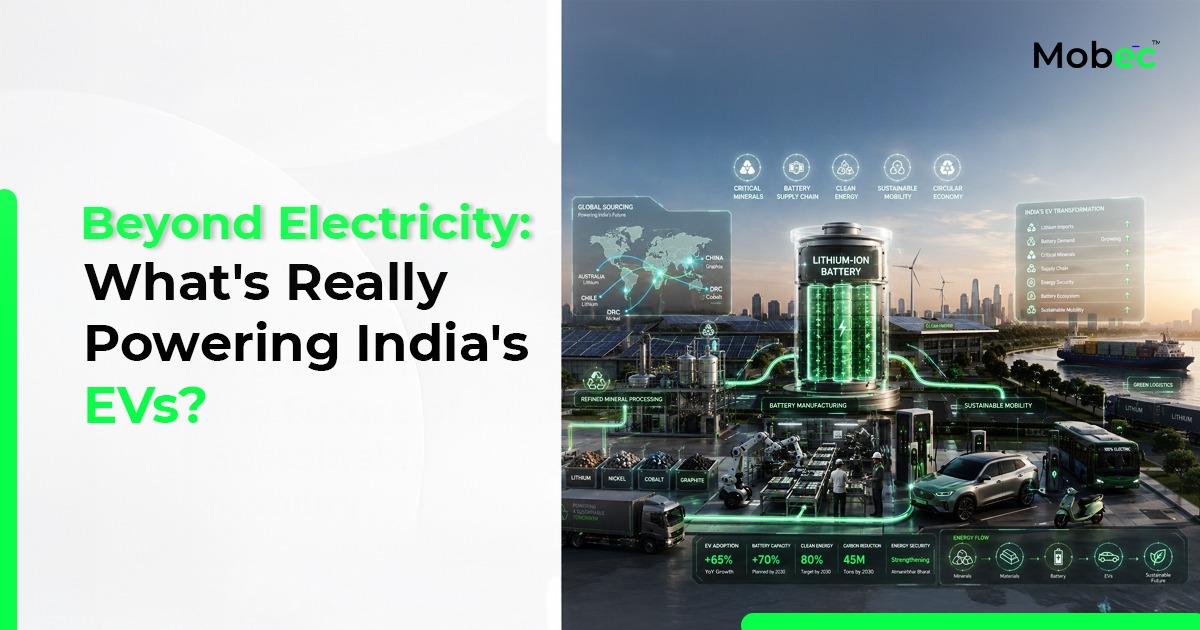
The answer isn’t just electricity, it’s a group of materials called critical minerals, and India depends heavily on importing them.
The Real Backbone of EVs: Critical Minerals
Every EV battery relies on minerals like lithium, cobalt, nickel, copper, and graphite. These are essential for building lithium-ion batteries, which power most electric vehicles today.
Here’s the reality in India:
- Lithium: 100% import dependent
- Cobalt: 100% import dependent
- Nickel: 100% import dependent
- Copper: majorly imported
- Graphite: majorly imported
This means India’s EV growth is directly tied to global supply chains.
Even battery imports reflect this trend. India’s lithium-ion battery imports surged from $384 million (2018–19) to $2.8 billion (2022–23), a massive jump driven by rising EV demand.
India’s EV Boom Is Real, But So Is the Dependency
India crossed 2.3 million EVs in 2025, and the numbers are only going up. Government incentives, fuel costs, and awareness are pushing adoption forward.
But there’s a catch.
India still imports 70–80% of its lithium-ion battery cells, meaning a large part of the EV ecosystem is not fully localised.
So while EV adoption is growing, control over the supply chain is still limited.
Global Supply Risks Are Increasing
The challenge becomes bigger when global factors come into play.
In 2025, China, a major player in battery manufacturing, introduced export controls on:
- High-performance lithium-ion batteries
- LFP cathode materials
- Artificial graphite anodes
These materials are critical for EV battery production.
For India, this creates pricing pressure, supply uncertainty, and long-term risk, especially as EV demand continues to rise.
India Is Responding, But It Takes Time
To reduce import dependence, India has started taking strategic steps.
One important move is the ₹169 crore India–EU critical minerals partnership, aimed at securing stable access to key materials and strengthening supply chains.
At the same time, the government launched the National Critical Mineral Mission (NCMM) in 2025, focusing on:
- Domestic exploration and mining
- Processing and refining capacity
- Recovery of minerals from used products
But here’s the challenge:
Mining takes years to scale.
So the question is – what can India do in the near term?
The Shift That Could Change Everything: EV Battery Recycling
This is where the story begins to shift.
For years, the EV conversation has been tied to imports and mining – sourcing lithium, cobalt, and nickel from across the world. But now, India is starting to look inward, unlocking value from what already exists.
EV battery recycling is no longer a future idea, it’s becoming a strategic priority.
The momentum is real:
- ₹1,500 crore in planned investments
- Strong national focus on recovering lithium, cobalt, and nickel at scale
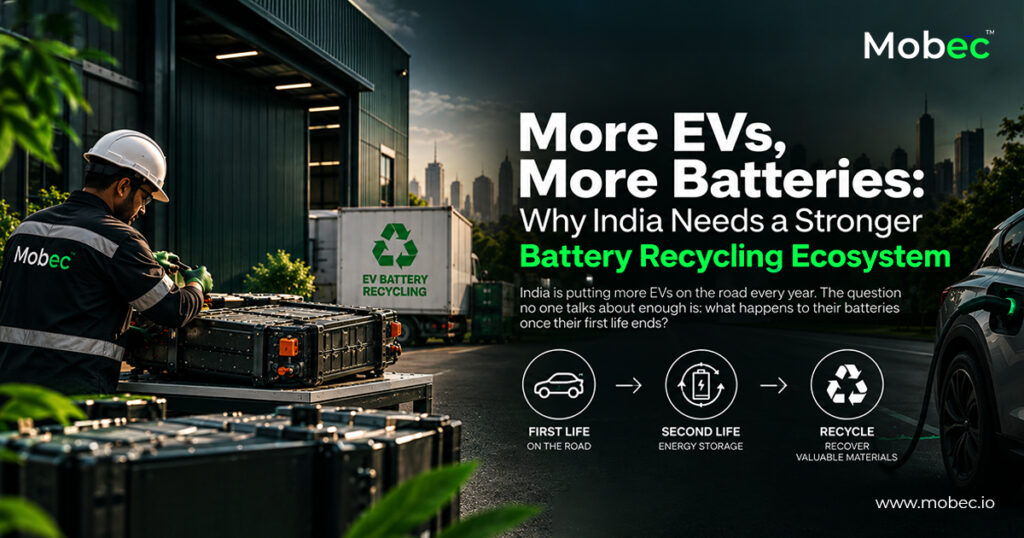
What this creates is more than efficiency, it builds a circular system. One where batteries don’t end their life, they begin a second one. Materials flow back into the ecosystem instead of being constantly imported.
And as this ecosystem evolves, the focus naturally expands.
It’s no longer just about producing vehicles, it’s about building the infrastructure that supports their entire lifecycle. From how energy is delivered, to how it is used, stored, and eventually reused.
At Mobec, this is the future we’re building toward.
Through smarter charging solutions, intelligent energy solutions, and a growing focus on lithium battery recycling, we are building a system where energy doesn’t just get consumed – it comes back into the loop.
At Mobec, recycling isn’t an afterthought. It’s a critical part of how we see the EV ecosystem evolving, where valuable materials are recovered, reused, and reintegrated to reduce dependence on imports and strengthen long-term sustainability.
Because the next phase of EV growth won’t be defined by adoption alone, it will be defined by how efficiently resources are cycled back into the system.
And that’s the future we’re actively building toward.
Second Life of EV Batteries Is Also Growing
Another important trend is the second-life use of EV batteries.
Even after they are no longer suitable for vehicles, batteries can still be used for:
- Energy storage systems
- Solar backup
- Grid support
This reduces waste and maximises the value of already imported materials.
So, What’s Really Powering India’s EVs?
It’s a mix of three things:
- Imported critical minerals
- Global supply chains
- Emerging recycling and infrastructure ecosystems
India’s EV story is not just about clean mobility, it’s about resource security and long-term sustainability.
Final Thought
India is clearly moving toward an electric future. But for that future to be stable and truly self-reliant, the focus has to go beyond just EV adoption.
The real shift will come from reducing import dependence and scaling lithium battery recycling at a national level.
Because at the end of the day, what powers EVs is not just energy, it’s the materials behind it.
Even today, a significant share of these critical materials is sourced externally, keeping the ecosystem heavily import-dependent.
At Mobec, we’re working to change that, by advancing lithium battery recycling to recover high-value minerals, reintroduce them into the supply chain, and reduce reliance on virgin resource extraction.
Because the future of EVs won’t just be defined by how much we build, but by how efficiently we can close the loop.