India is building millions of EVs.
But for fleet operators, the real challenge isn’t charging anymore, it’s what happens to the battery next. EV adoption is accelerating rapidly across the country.
In 2025 alone, India recorded over 2.3 million EV sales, with fleet operations playing a major role in this growth. But alongside this expansion, a parallel issue is becoming impossible to ignore: battery lifecycle management.
In the past year, India processed nearly 50,000 tonnes of lithium-ion battery waste. By 2026, this is expected to cross 60,000 tonnes, with total recycling capacity exceeding 100,000 tonnes annually.
The issue is not capacity.
It’s execution.
Today, only 25–30% of used batteries are being collected and routed through formal recycling systems. For businesses operating EV fleets, this gap directly translates into compliance risk, rising costs, and lost material value.
EV Growth Is Now a Lifecycle Management Problem
For most fleet operators, battery replacement is already one of the largest hidden costs.
Without a structured recycling pathway, that cost only increases over time.
As EV adoption expands beyond metro cities into logistics, mobility, and delivery fleets, a predictable outcome is emerging: a large volume of batteries entering end-of-life cycles in the next few years.
The technology to manage this already exists. Modern recycling systems can recover 70–95% of key materials, including:
- Lithium
- Cobalt
- Nickel
However, two critical gaps continue to limit real-world efficiency:
- Limited visibility into battery lifecycle and degradation
- Weak reverse logistics and collection systems
At the same time, India still imports 70–80% of these critical materials, making recycling not just an environmental need, but a strategic supply chain advantage.
EPR Compliance Is Now an Operational Requirement
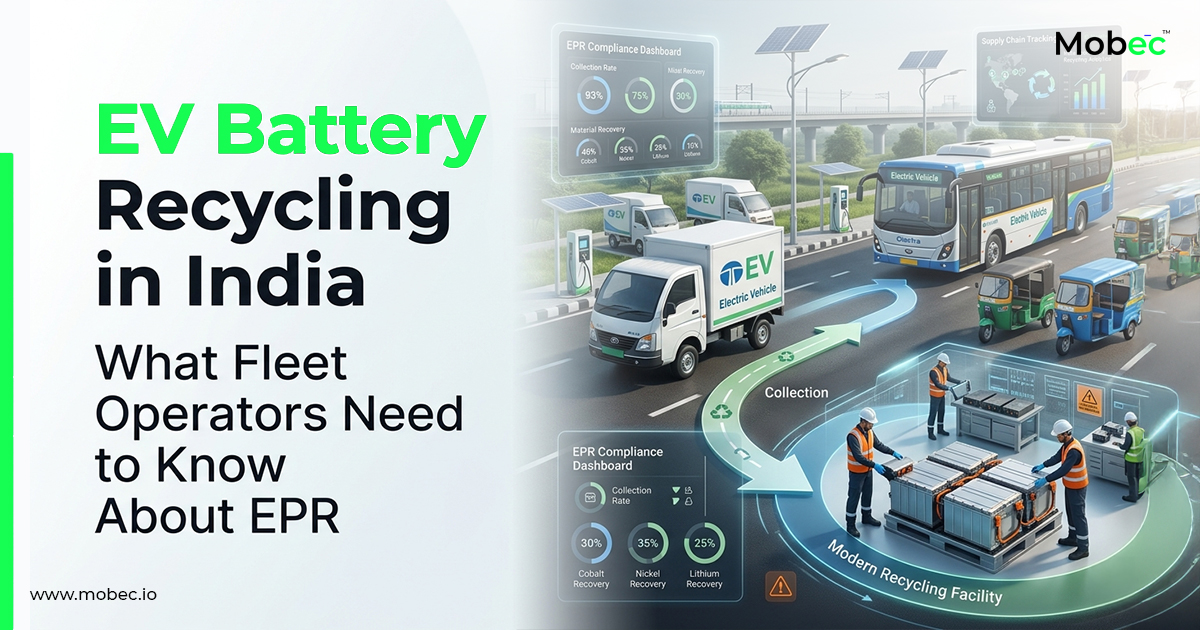
Under the Battery Waste Management Rules (2022), companies are responsible for managing batteries at the end of their life through Extended Producer Responsibility (EPR).
This includes:
- Collection of used batteries
- Meeting recovery and recycling targets
- Maintaining traceability through CPCB systems
With 90% recovery targets coming into force by 2027, compliance timelines are tightening rapidly. Already, 4,000+ producers are registered under the EPR framework. For fleet operators, this is no longer a policy discussion. EPR is becoming a core operational, financial, and compliance function.
Where Fleet Operations Currently Fall Short
Most EV fleets today still operate with a fragmented model:
- Charging is managed separately from battery health tracking
- End-of-life identification is reactive, not planned
- Collection and recycling are outsourced without integration
- No unified system linking usage to disposal
This results in:
- Delayed or incomplete compliance
- Higher battery replacement costs
- Loss of recoverable material value
- Limited visibility into long-term fleet performance
Mobec: Connecting the Entire Battery Lifecycle
As EV adoption grows, managing batteries doesn’t stop at charging, it extends all the way to recovery and reuse.
Mobec is designed to bring these stages together, helping fleet operators manage the full battery lifecycle more efficiently.
With India expected to generate over 250,000 tonnes of battery waste annually by 2030, solutions that connect usage with recovery are becoming increasingly important.
1. Charging That Works in the Real World
For many fleets, the challenge isn’t just charging, it’s finding reliable charging when and where it’s needed.
Mobec focuses on bringing charging to the point of demand, instead of relying only on fixed infrastructure.
That means:
- Less downtime when vehicles can’t find chargers
- More flexibility across locations
- Smoother day-to-day operations
Because in real fleet operations, access matters just as much as availability.
2. Reducing Operational Gaps in EV Fleets
As EV adoption grows, fleets often deal with gaps, between infrastructure, usage, and planning.
By combining portable charging and energy support, Mobec helps reduce these gaps:
- Charging doesn’t stay limited to fixed points
- Operations don’t pause due to infrastructure limitations
- Fleets can function more consistently across different environments
It’s a more practical way to support EV operations as they scale.
3. Turning Used Batteries into a Resource
When a battery reaches end-of-life, it still holds significant value.
Mobec’s recycling capabilities focus on recovering key materials like:
- Lithium
- Cobalt
- Nickel
- Graphite
These materials can be brought back into the supply chain, helping:
- Reduce dependence on imports
- Support India’s growing EV ecosystem
- Move towards a more circular model
So instead of waste, batteries become part of a value loop.
4. Connecting Usage to Recovery
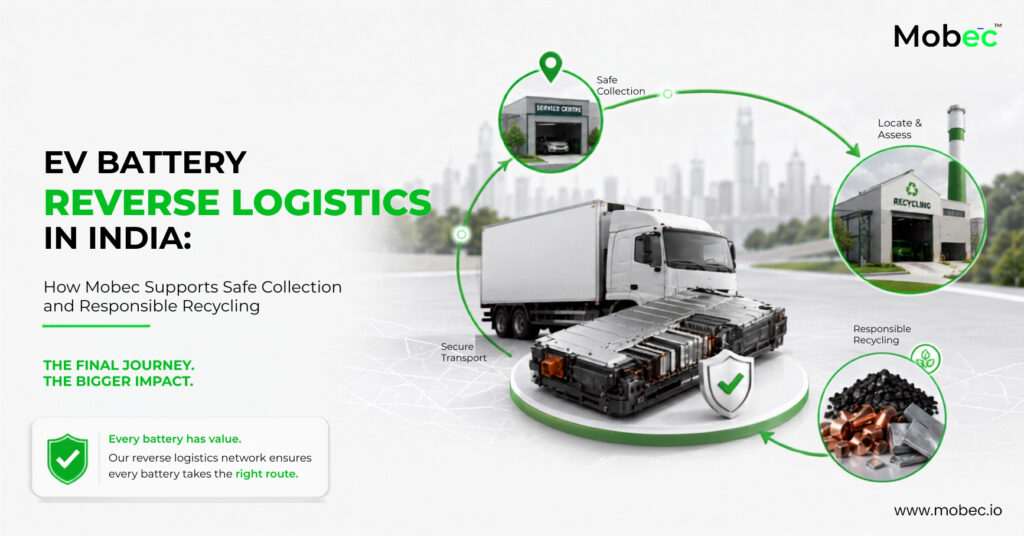
One of the biggest real-world challenges isn’t recycling, it’s ensuring batteries actually reach recycling systems.
Mobec helps create a smoother transition by connecting:
- Charging and usage
- Collection and movement
- Recycling and recovery
Through structured systems and network support, batteries can move more efficiently from end-of-use to processing, improving both recovery and compliance readiness.
What Fleet Operators Can Start Doing Today
Steps you can start with:
- Start tracking battery usage and replacement cycles
- Standardize charging practices across locations
- Maintain basic digital records for reporting and compliance
- Work with CPCB-registered recycling partners
- Build a simple, repeatable collection process
- Allocate 2–3% of fleet cost toward recycling and compliance planning
Conclusion: The Next Phase of EV Growth
India’s EV story is moving beyond just adoption.
Charging will always be important, but it’s no longer the full picture.
What happens to the battery after use is becoming just as critical.
The next phase of EV growth will be defined by how well businesses can manage:
- Usage
- Operations
- And end-of-life recovery
By bringing together charging, energy support, and recycling, Mobec is helping move EV ecosystems toward something more complete –
not just scalable, but practical, efficient, and built for the long term.