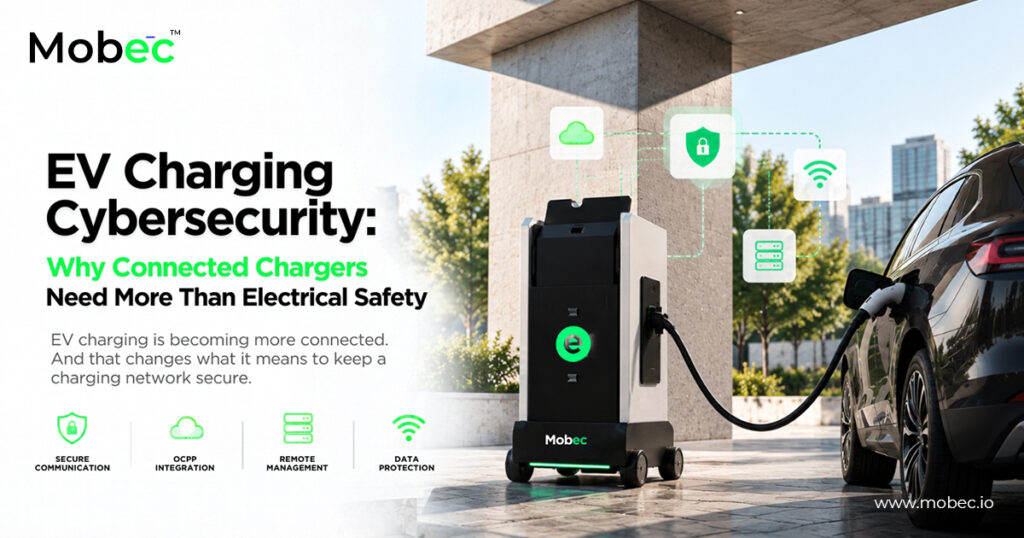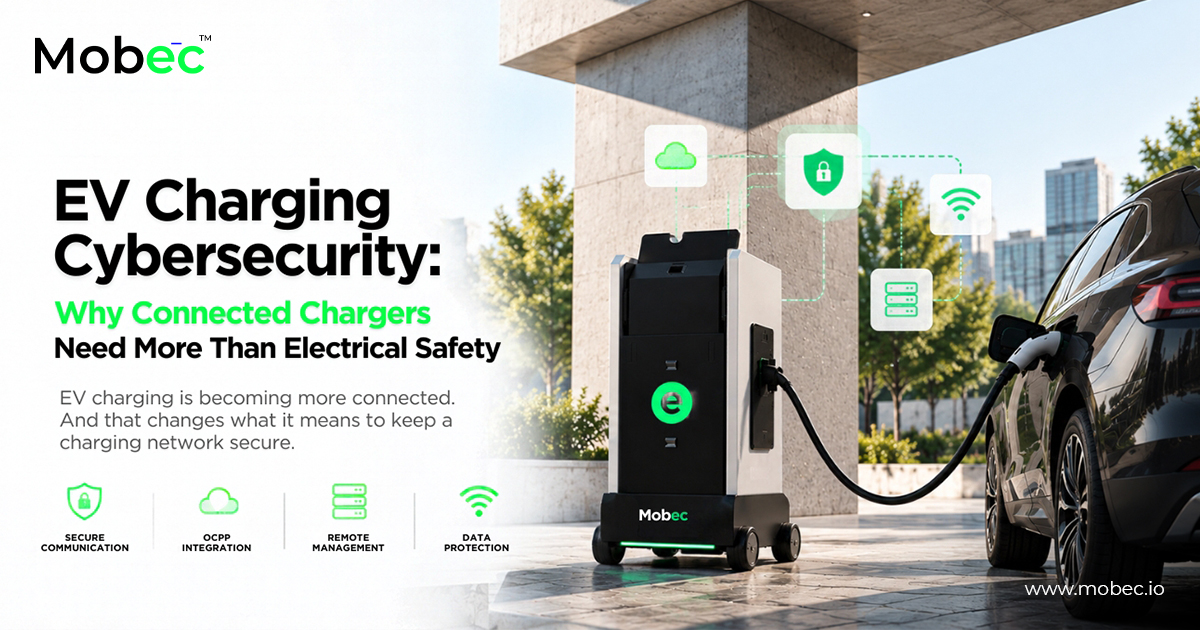
EV charging is becoming more connected. And that changes what it means to keep a charging network secure.
A charger today can do much more than deliver power. It can communicate with backend systems, exchange data, receive remote commands, support software and firmware updates, and connect with wider energy-management platforms.
Protocols such as OCPP make this connected operation possible, helping charging stations communicate with charging management systems and other digital infrastructure.
But every connected layer also introduces another question:
How secure is the digital infrastructure behind the charger?
At Mobec, we believe reliable EV infrastructure has to account for both sides of the equation. Electrical safety protects the physical charging experience. Cybersecurity helps protect the connected systems that make modern charging possible.
And as India’s charging network expands, EV charging cybersecurity is becoming an infrastructure concern, not simply an IT concern.
Why Are EV Chargers Becoming a Cybersecurity Concern?
India’s public EV charging network is already operating at significant scale. According to a written reply from the Ministry of Heavy Industries in Parliament in July 2026, India has 52,718 public EV charging stations, including 16,561 equipped with fast chargers for cars.
The important change is not just the number of chargers. It is how those chargers are connected.
A modern charging station may communicate with a:
- Charging Station Management System (CSMS)
- Cloud platform or charging network
- Payment or authentication system
- Mobile application
- Energy-management system
- Other charging infrastructure
- Vehicle through charging protocols
So while the charger still has to get the electrical side right, there is now a digital layer to protect as well.
A charger can meet its electrical safety requirements and still have vulnerabilities in its software, communication channel, firmware, credentials or backend connection.
That is why EV charger security needs to go beyond electrical protection.
At Mobec, this is an important shift in how charging infrastructure needs to be designed and managed. A charger is no longer an isolated electrical device. It is part of a connected system, and that connection needs to be considered alongside performance, uptime and electrical safety.
The future of charging is not simply about putting more chargers on the road. It is about making sure those chargers continue to work reliably as they become more connected, remotely managed and integrated with other systems.
What Does OCPP Have to Do With EV Charging Security?
OCPP, or the Open Charge Point Protocol, allows charging stations and charging management systems to communicate with each other.
One of its biggest advantages is interoperability. Hardware and software from different providers can communicate without every charging network having to depend on a completely proprietary system.
Mobec’s approach to connected charging therefore looks beyond the physical hardware and considers how the charger communicates, how access is controlled and how the system is managed remotely.
OCPP 1.6 remains widely implemented, while OCPP 2.0.1 and OCPP 2.1 bring additional capabilities around security, device management and smart charging.
But once a charger is communicating with another system, that communication needs to be protected.
In February 2026, the Open Charge Alliance published the fourth edition of its OCPP 1.6 Security Whitepaper, covering areas such as secure connection setup, security event logging and secure firmware updates.
Then came another important development.
In September 2026, the Open Charge Alliance released Version 2 of its Security Operations Guide. The updated guide expands security guidance for CSMS providers and Charge Point Operators and adds guidance on local controllers.
The OCA also describes charging infrastructure as critical infrastructure because security issues can have consequences for the electricity grid and wider society.
For an industry that is still scaling, that is an important signal: security needs to be considered alongside connectivity and interoperability, not after them.
Where Can an EV Charging Cybersecurity Risk Enter?
The risk does not necessarily sit in one place. It can exist across the different systems that make a connected charging network work.
1. The Charging Station
The charger itself contains software, communication interfaces and configuration settings.
Weak authentication, outdated firmware or poorly secured interfaces can create opportunities for unauthorized access.
2. The Connection to the Backend
A connected charger often communicates with a CSMS through a network connection.
If authentication or session management is poorly implemented, someone could potentially try to impersonate a legitimate charging station or interfere with communications.
Several vulnerabilities documented in 2026 involved predictable WebSocket session identifiers in EV charging systems. Depending on the affected implementation, such weaknesses could potentially allow unauthorized authentication, session hijacking or denial-of-service conditions.
The point is not that every connected charger has this weakness. It is that the communication layer itself needs to be designed and maintained securely.
3. OCPP and Communication Security
It is also important to distinguish between a protocol and how that protocol is implemented.
OCPP itself is not automatically a security weakness. The way an individual product implements, validates and protects OCPP communication matters.
In 2026, vulnerabilities were disclosed in specific EV charging systems involving OCPP-related functionality. Reported issues included command injection through OCPP message handling and diagnostic functions, demonstrating how weaknesses in implementation can potentially be used to execute unauthorized commands.
These cases do not mean that OCPP is inherently unsafe. They show why secure implementation, authentication, input validation and ongoing vulnerability management are important.
4. Firmware and Software Updates
Installing a charger is not the end of its security lifecycle.
Connected infrastructure needs to be maintained throughout its operational life. That includes secure firmware updates, controlled access, vulnerability monitoring and appropriate security logging.
In other words, securing a charging station is not a one-time task.
Looking at these layers together is important because charging reliability does not come from the charger hardware alone. The device, network, backend systems and software updates all form part of the infrastructure.
Why Does This Matter for India’s EV Charging Network?
India’s EV charging ecosystem is becoming more connected as the network expands.
Charging stations now sit alongside software platforms, payment systems, remote monitoring, energy management and other digital services. As more of these systems communicate with each other, the security of those connections becomes increasingly important.
So the question is no longer whether charging infrastructure will be connected.
It is how securely that connection will be managed.
A security incident could potentially affect charging availability, operational data, user information or remote management, depending on the systems involved and the level of access an attacker obtains.
This is where the broader infrastructure conversation matters.
The goal is not simply to install more chargers. It is to help create infrastructure that is practical, scalable and ready for the way electric mobility is evolving.
What Should Secure EV Charging Infrastructure Look Like?
There is no single feature that makes a charging network secure.
Instead, security needs to be considered across the different layers of the system.
Some of the important considerations include:
- Strong device and user authentication
- Secure communication between chargers and CSMS platforms
- Proper OCPP security implementation
- Secure firmware and software updates
- Controlled access and credential management
- Security logging and monitoring
- Regular vulnerability assessment and patching
- Network segmentation where appropriate
- Clear security responsibilities between CPOs, CSMS providers and other stakeholders
- Security testing before and during deployment
The broader point is simple: one security control cannot protect an entire connected charging network.
A network may have hundreds or thousands of connected devices operating across different locations. Security needs to be considered across the charger, communication layer, backend systems and the processes used to manage them.
Electrical Safety Is Only One Layer
At Mobec, we see this as part of the larger evolution of EV infrastructure.
Electrical safety will always be fundamental. But connected charging adds another responsibility: making sure the digital systems behind that physical connection can be trusted.
The charger communicates with other systems. It exchanges information, can be monitored remotely and, depending on the setup, can receive commands from a backend platform.
That changes what “safe charging” needs to mean.
It is no longer only about whether electricity is delivered safely to the vehicle. It is also about whether the systems managing that charging connection can be trusted.
Our work across AC and DC charging, energy systems and battery recycling gives us a broader view of how these parts of the EV ecosystem are becoming increasingly connected. That makes reliability, security and responsible infrastructure management important considerations as the ecosystem grows.
The next generation of charging infrastructure will not be defined only by how fast a charger can charge.
It will also be defined by how reliably, safely and securely it can operate.