India’s rooftop solar market is evolving beyond electricity generation. As more households explore renewable energy to manage electricity costs, attention is shifting towards a critical question: how can homes make better use of the power their solar panels produce?
Home energy storage offers one answer. By storing electricity for later use, battery systems can help households improve solar self-consumption, access backup power where supported, and manage changing household energy needs.
For India, where electricity demand, weather conditions and household consumption patterns vary considerably across regions, the combination of rooftop solar and battery storage represents an important development in residential energy management.
India’s Rooftop Solar Growth Is Creating New Opportunities
Government initiatives are helping bring rooftop solar into mainstream residential energy planning. The PM Surya Ghar: Muft Bijli Yojana, launched in 2024, has a financial outlay of ₹75,021 crore and aims to support rooftop solar installations in one crore households.
By August 2026, the scheme had crossed 50 lakh rooftop solar installations, with approximately 14.8 GW of rooftop solar capacity commissioned under the programme. This progress reflects the growing role of decentralised solar power in India’s residential energy landscape.
However, installing solar panels is only one part of the equation. Solar generation is concentrated during daylight hours, while many households experience substantial electricity demand in the evening. Without storage, the ability to use solar-generated electricity after sunset depends on the system configuration, grid connection and applicable metering arrangements.
This is where home energy storage becomes relevant.
How Home Energy Storage Complements Rooftop Solar
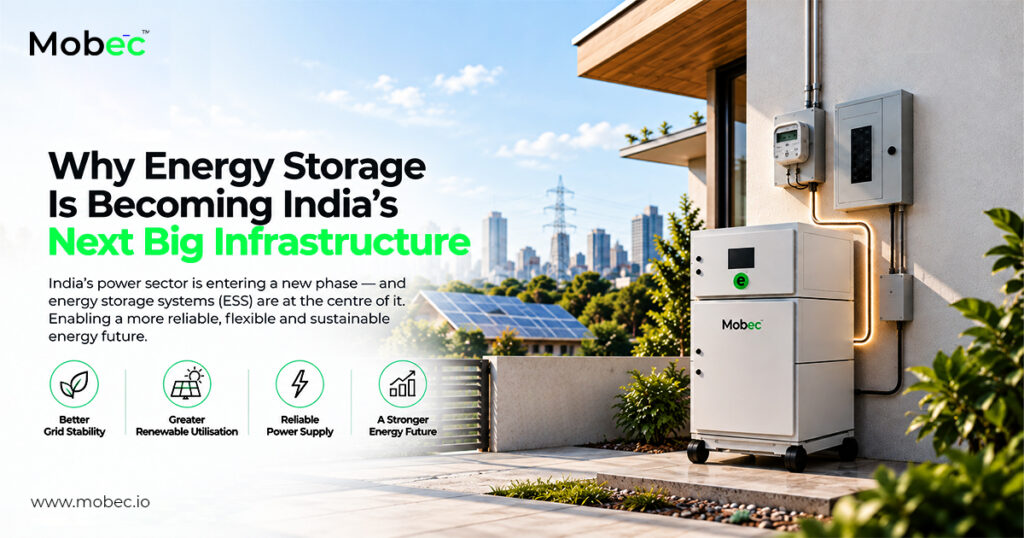
A rooftop solar system generates electricity when sunlight is available. A home energy storage system adds the ability to store energy and use it later, depending on the system’s design and operating configuration.
During the day, surplus solar generation can charge a compatible battery. When solar output declines, stored energy can help supply connected household loads.
The practical benefits can include:
- Better solar utilisation: Store eligible surplus generation for use when household demand rises.
- Backup power: Keep compatible essential loads running during outages when the system supports backup operation.
- Greater energy flexibility: Manage when stored electricity is used according to household requirements.
- Potential electricity bill savings: Reduce grid electricity consumption in suitable configurations, depending on tariffs, system efficiency, usage patterns and export compensation.
Storage does not automatically eliminate electricity bills or guarantee uninterrupted power. Outcomes depend on battery capacity, inverter compatibility, household demand and the way the system is configured.
Government Subsidies and Policy Developments in India
India is encouraging residential rooftop solar adoption through initiatives such as the PM Surya Ghar: Muft Bijli Yojana, which provides financial assistance to eligible households installing rooftop solar systems.
Under the standard central subsidy structure, eligible households in most states can receive ₹30,000 per kW for the first 2 kW and ₹18,000 for the additional 1 kW, with the maximum central subsidy capped at ₹78,000 for systems of 3 kW or more. Benefits are subject to the scheme’s eligibility criteria and applicable guidelines.
Bihar’s Rooftop Solar Policy: State-Level Support
Bihar is also supporting residential rooftop solar adoption through state-level financial assistance linked to the PM Surya Ghar scheme. On 14 August 2026, the Bihar Energy Department published a resolution concerning additional assistance for residential consumers, alongside administrative and expenditure approval of ₹1,000 crore for implementation.
The state also published an allocation of ₹49.42 crore for FY 2026–27 towards additional assistance for eligible residential consumers. These measures highlight the importance of checking state-specific incentives alongside central subsidies when evaluating rooftop solar investments..
For homeowners, the actual subsidy available depends on eligibility, applicable state and central provisions, and the approved application process. The latest official guidelines should be consulted before making an investment decision.
While these incentives primarily support eligible rooftop solar installations, home energy storage addresses a related but distinct need: making electricity available when it is needed. Battery systems can help households use stored energy after solar generation declines and support compatible loads during power interruptions. However, a separately purchased home battery should not be assumed to qualify for the same solar subsidy.
As rooftop solar adoption expands across India, understanding both policy incentives and energy storage options can help households make more informed decisions about their residential power systems.
The Industrial Perspective: Storage Is About More Than Capacity
Battery capacity alone does not determine how useful a home energy storage system will be. The relationship between the battery, inverter, solar input and household load is equally important.
A household that primarily needs evening energy may have different requirements from one that prioritises backup during power interruptions. Appropriate sizing therefore involves understanding consumption patterns, essential loads, desired backup duration and the system’s operating limits.
Compatibility also matters. Solar and grid integration, supported inverter configurations, charging behaviour, protection features and installation quality all influence practical performance.
At a broader level, India’s policy framework increasingly recognises energy storage as an important part of a flexible electricity system. The Ministry of New and Renewable Energy maintains dedicated guidance on energy storage, including battery energy storage initiatives and grid integration.
Although large-scale grid storage and residential batteries serve different purposes, both reflect the same underlying requirement: electricity must be available when and where it is needed.
From Rooftop Solar to Smarter Home Energy Management
As rooftop solar becomes more accessible across India, home energy storage adds another dimension to how households manage electricity. Solar generation varies throughout the day, while consumption depends on household routines, appliance usage and backup requirements. A well-matched storage system can help bridge this gap by making stored energy available when needed.
Mobec Homez ESS brings this approach into the residential energy landscape, with configurations designed around different power requirements. When evaluating a system, homeowners need to consider battery capacity, inverter output, solar and grid compatibility, and the loads they intend to support. These factors help determine whether a storage solution meets their everyday energy and backup needs.
Building a More Flexible Energy Future for Indian Homes
India’s residential energy transition will depend not only on expanding renewable energy generation, but also on making electricity use more adaptable to changing household needs. As solar adoption grows, informed decisions about system design, storage capacity and energy management will become increasingly important.
At Mobec, we see home energy storage as an important part of this shift. Through solutions such as Homez ESS, we aim to support households exploring more flexible ways to manage their power requirements as residential energy systems evolve.