Electric vehicles are no longer a rare sight on Indian roads. From daily office commutes to business fleets and family cars, EVs are steadily becoming part of everyday life across the country. Better models, rising fuel prices, and supportive policies have made the shift to electric both practical and appealing.
But buying an EV is only part of the story.
The real convenience of electric mobility depends on how easily you can charge your vehicle. While public charging stations are expanding, most EV owners prefer the simplicity of charging at home. And that’s where the conversation is shifting, from just owning an EV to upgrading homes with smarter, safer, and more structured charging solutions.
Wall-mounted EV chargers are quickly becoming that upgrade.
The Urban EV Reality: Growth Meets Infrastructure Gaps
India’s EV ecosystem is expanding rapidly, supported by government incentives, rising fuel costs, and growing environmental awareness. With Delhi EV Policy 2.0 emphasizing neighborhood-level EV charging infrastructure, the spotlight is shifting from public charging stations to residential and workplace charging solutions.
Public charging stations are increasing steadily across NCR and other metro cities. However, EV owners still face common challenges:
- Long queues during peak hours
- Inconsistent charger availability
- Limited overnight public access
- Dependence on crowded urban charging hubs
For many EV users in Delhi NCR, Ghaziabad, Noida, and Greater Noida, the convenience promised by electric mobility often feels incomplete without reliable home charging.
The reality is simple: urban EV growth demands smarter residential charging solutions.
The Global EV Charging Surge: Why Wall-Mounted Chargers Are Leading
Globally, the EV charging infrastructure market is projected to reach $5.6 billion by 2033, growing at nearly 17% CAGR. A significant portion of this growth is driven by AC wall-mounted EV chargers for homes and offices.
Why are wall-mounted chargers becoming essential?
- 70–80% of EV charging happens at home or workplace
- AC chargers are cost-effective compared to DC fast chargers
- Overnight charging supports better battery health
- Smart energy management reduces electricity strain
In India, initiatives like the FAME India Scheme have accelerated EV adoption by offering incentives and infrastructure support. As more homeowners in Uttar Pradesh, Delhi NCR, and other urban hubs transition to EVs, demand for home EV chargers in India is rising sharply.
The trend is clear: public charging supports mobility, but home charging defines convenience.
The Real Home Charging Problem: From Chaos to Control
Imagine a working professional in Dadri or Noida:
They’ve purchased an electric car for cleaner daily commutes. Excited about sustainable mobility, they install a basic plug-point setup in their garage.
But soon, problems appear:
- Charging cables lying loosely
- No proper mounting structure
- Fluctuating power output
- No app tracking or monitoring
- No scheduling for off-peak electricity tariffs
What started as an eco-friendly upgrade becomes a daily inconvenience.
This is where structured, wall-mounted EV charging infrastructure becomes critical. It’s no longer a premium add-on, it’s foundational equipment for serious EV ownership.
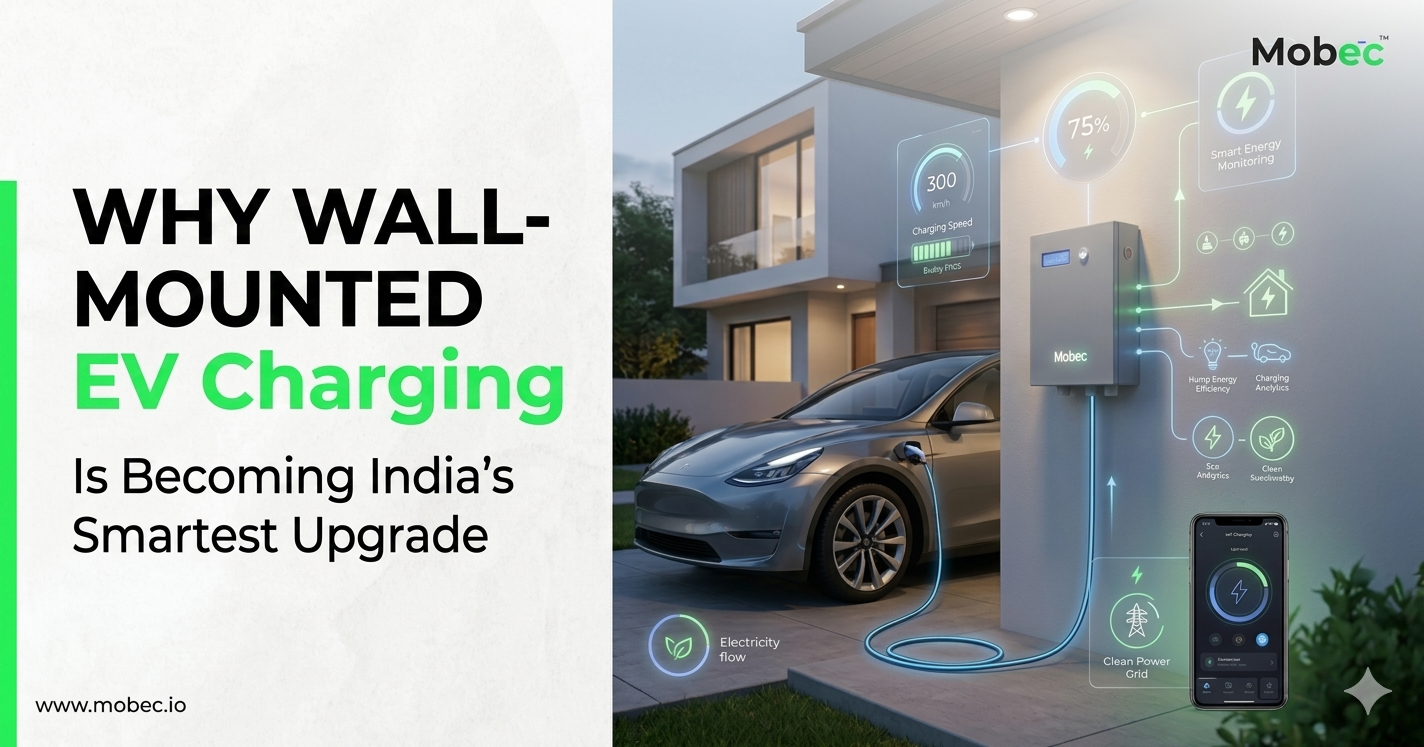
A dedicated wall-mounted EV charger in India ensures:
- Organized cable management
- Stable power delivery
- Safe installation
- Smart monitoring
- Long-term electrical reliability
Enter Mobec EV11: Smart Charging Built for Urban India
As EV demand grows across Delhi NCR, Uttar Pradesh, and emerging smart cities, solutions must evolve.
Mobec EV11 is designed specifically for modern Indian homes and workplaces.
Key Features:
- 11 kW AC output (upgradable to 22 kW)
- Compact wall-mounted design
- Configurable power output
- App-enabled monitoring
- Ideal for residential and commercial EV charging
Instead of chaotic cables and uncertain power, the EV11 transforms unused wall space into a structured smart charging station.
It supports:
- Overnight EV charging
- Load optimization
- Clean, space-saving installation
- Seamless integration with home electrical systems
For fleet operators and businesses, it complements portable charging solutions like Mobec Lightning, contributing to a broader sustainable EV ecosystem.
In fast-growing EV markets like Delhi, Noida, and Greater Noida, structured home charging is becoming a competitive necessity, not a luxury.
Why This Matters Now: Infrastructure Defines Adoption
India is adding over 29,000 public EV chargers nationwide, yet urban density continues to rise. As electric vehicle adoption in India increases, private charging infrastructure will determine:
- Consumer confidence in EV ownership
- Grid load management
- Battery performance optimization
- Daily commuting convenience
- Long-term sustainability
The next phase of India’s EV growth will not be decided solely by vehicle launches.
It will be defined by charging accessibility, smart infrastructure, and residential readiness.
If public charging builds momentum, home charging builds trust.
Conclusion: Powering India’s EV Future from the Wall Up
The shift toward electric mobility in India is irreversible. Cities like Delhi, Noida, and Gurugram are leading the way, supported by progressive EV policies and rising environmental consciousness.
But true EV convenience begins at home.
Wall-mounted EV chargers like Mobec EV11 are not just products, they represent a shift toward structured, intelligent, and dependable charging ecosystems.
From garage chaos to seamless smart charging, the future of Indian mobility will be powered as much by neighborhood walls as by highways.
And as EV adoption accelerates, one thing becomes clear:
The smarter the charging infrastructure, the stronger the electric revolution.