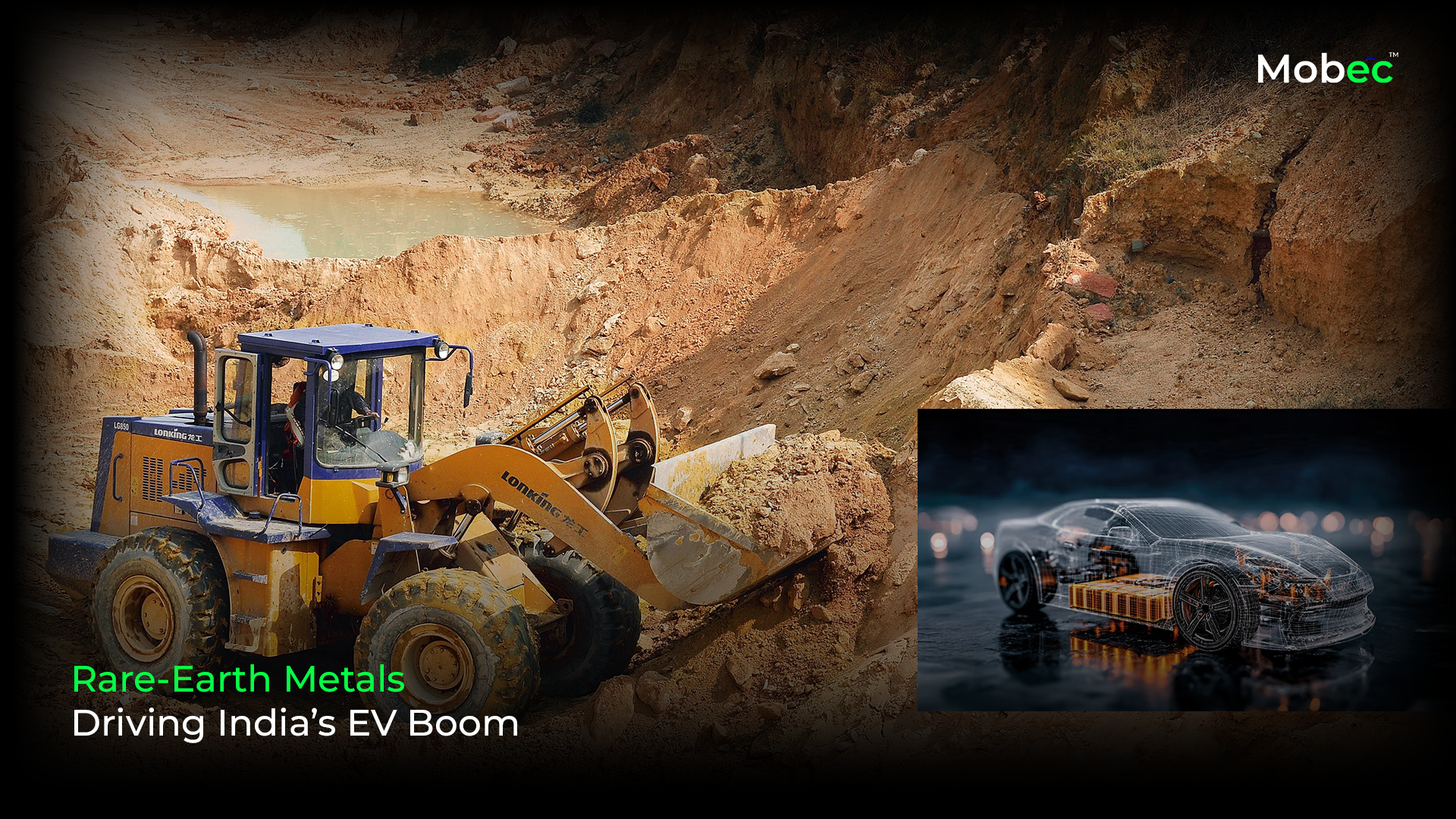
India’s electric vehicle (EV) revolution is picking up speed, and 2025 onwards is expected to be the decade that transforms mobility in the country. But behind every EV – every battery pack, motor, thermal system, and electronic unit – lies a group of metals quietly running the show. These are rare-earth and battery-critical metals, and they are becoming as important to India’s future as oil once was.
Recent analyses show that India’s rapid shift toward electric vehicles has sharply increased the demand for key minerals such as lithium, cobalt, nickel, copper, aluminium, zinc, and rare-earth elements like neodymium and praseodymium. These materials are essential for scaling EV production. As the country pushes for faster adoption and greater self-reliance, a new wave of companies is emerging to strengthen India’s mineral and manufacturing backbone.
Why Rare-Earth Metals Are Suddenly So Critical
Electric vehicles use almost six times more minerals than traditional petrol or diesel vehicles. A typical EV requires:
- Copper rising from ~20 kg in an ICE vehicle to 85+ kg
- Over 250 kg of aluminium for the lightweight EV architecture
- Zinc and magnesium for casings, cooling plates, and battery housings
- Rare-earth elements like neodymium for the permanent magnets used in EV motors
India registered 1.3 million EVs in FY25, and battery pack capacity is expected to rise from ~12 GWh to nearly 50 GWh by 2030. With this growth, the demand for these metals is expected to rise sharply – making rare-earth and critical minerals the “fuel” of the EV era.
The Companies Strengthening India’s EV Materials Supply Chain
The major companies that are quietly becoming essential to India’s EV ecosystem:
1. Hindustan Zinc (HZL)
Traditionally a zinc and silver producer, HZL manufactured over 1.03 million tonnes of zinc this financial year, a metal widely used in EV battery casings, thermal systems and structural parts. The company is also exploring entry into rare-earth mining through monazite deposits, which contain metals like neodymium that are critical for EV motor magnets.
2. Owais Metals
One of the fastest-growing players, Owais Metals produces high-strength aluminium and copper alloys used in EV power electronics, battery enclosures and motors. The company also operates a rare-earth recycling stream, recovering elements like niobium, tantalum and tin with a purity of 99.9%. Its FY25 performance was impressive: a 166% jump in sales, and profits more than tripled.
3. Sterling Tools
Sterling Tools specializes in precision fasteners for cars, commercial vehicles, two-wheelers, and farm equipment. Its EV business contributes 42% of revenue, growing nearly 60% YoY, and the company has expanded into EV drivetrain components. Over the past three years, revenue grew at a CAGR of 26%, net profit by 32%, and exports now make up 16% of revenue.
4. Coal India (CIL)
Coal India may not produce rare-earths today, but it controls one of India’s largest untapped sources of them: coal ash. Coal ash contains trace amounts of rare-earth elements (REEs) like neodymium, praseodymium, scandium and yttrium, all critical for EV motors, batteries, and power electronics.
With India generating over 275 million tonnes of coal ash every year, CIL has begun pilot projects to extract REEs from this waste stream, potentially creating a large domestic source of rare-earth materials. This is crucial at a time when EV demand is rising and global REE supply is dominated by China.
CIL’s strong finances , ₹280 bn+ cash flows, negligible debt, and a 10% sales / 16% profit CAGR, give it the capacity to scale rare-earth extraction and support India’s mineral security.
5. GMDC (Gujarat Mineral Development Corporation)
A government-backed miner exploring bauxite, lignite, silica sand and fluorspar, all important for EVs and battery manufacturing. GMDC is expanding into rare-earth extraction and processing, building a complete supply chain to support India’s EV ambitions.
Together, these companies form the backbone of India’s mineral security, and Mobec Innovations contributes to this vision through its focus on circularity and responsible resource use. This domestic strength is crucial at a time when China dominates global rare-earth processing. A resilient homegrown ecosystem not only reduces dependency but also protects India from future supply disruptions.
Why Recycling Is Now the Most Important Part of the EV Story
Even with strong mining and metal-producing companies, India’s mineral demand will eventually outpace supply. That’s why recycling and refurbishment have become game-changing strategies. By extracting critical minerals from used EV batteries, India can:
- Cut battery manufacturing costs
- Reduce import dependency
- Lower environmental damage
- Build a circular, self-sustaining supply chain
Government rules are already pushing in this direction. India’s Battery Waste Management Rules (2022) require manufacturers to recover up to 90% of battery materials by 2027 and gradually increase recycled content in new batteries.
This is exactly where Mobec steps in.
Mobec’s Refurbishment & Recycling: Closing the Loop for India’s EV Future
Mobec Innovation is emerging as one of India’s strongest players in the circular EV ecosystem. Our newly established lithium-ion battery recycling plant, with a capacity to process 6,000 tons per year, is designed to extract valuable metals such as lithium, cobalt, nickel, manganese, copper, and graphite.
Using advanced hydrometallurgical and mechanical processes, Mobec achieves material recovery rates of up to 99%, ensuring that nearly every usable metal is reclaimed. This recovered material is then re-channeled into battery manufacturing or industrial use, creating a closed-loop, circular economy model.
Mobec’s work does more than just recycle:
- It reduces India’s dependence on imported critical minerals
- It prevents battery waste from ending up in landfills
- It makes EV manufacturing cheaper and more sustainable
- It ensures India has long-term access to essential EV materials
As EV adoption increases, Mobec’s refurbishment and recycling systems will become one of the strongest pillars of India’s clean mobility mission.
The Road Ahead
India’s EV revolution isn’t just about vehicles, it’s about the materials that power them. Rare-earth metals and critical minerals are the building blocks of the EV era, and at Mobec, we understand how crucial these resources are for India’s clean-mobility future.
But the future belongs to circular systems. That’s why our recycling and refurbishment initiatives focus on building a cleaner, smarter, and more resilient EV supply chain, one where resources aren’t wasted, and every battery gets a meaningful second life.