Delhi’s electric transition has reached an interesting point.
People are no longer asking whether electric vehicles will become mainstream. They are asking more practical questions: Will an EV save me money? Where will I charge it? And will Delhi’s charging infrastructure grow fast enough to support everyday use?
The Delhi EV Policy 2.0, introduced as the Delhi Electric Vehicle Policy 2026, attempts to answer these questions through stronger purchase incentives, scrappage benefits, registration timelines and an ambitious expansion of the city’s EV charging network.
The policy is no longer simply about convincing Delhi to consider electric mobility. It is about preparing the city to live with it.
What Does Delhi EV Policy 2.0 Change?
Among the policy’s key announcements are:
- Up to ₹30,000 in incentives for eligible electric two-wheelers
- Up to ₹1 lakh in scrappage benefits for eligible car owners
- Road tax and registration fee exemptions for electric cars priced up to ₹30 lakh
- More than 30,000 EV charging points planned by 2030
- New registration timelines for petrol and CNG vehicle categories
These figures make strong headlines. But the more important story is what they could change on Delhi’s roads.
Switching to an EV Could Become More Affordable
Electric two-wheelers are eligible for incentives of up to ₹30,000, helping reduce the upfront cost for buyers. Those replacing an eligible petrol or CNG two-wheeler may also qualify for an additional scrappage benefit.
For electric cars priced up to ₹30 lakh, the policy offers exemptions from road tax and registration fees. Owners who scrap eligible older cars and replace them with battery electric vehicles may receive a scrappage incentive of up to ₹1 lakh.
Electric three-wheelers and light commercial vehicles receive support too, and their transition could have an even more visible impact.
A private car may remain parked for most of the day. Autos, delivery vehicles and commercial fleets rarely do. Electrifying the vehicles that spend longer hours on Delhi’s roads could reduce fuel consumption and tailpipe emissions more immediately.
The policy also places a timeline on the shift. From 1 April 2028, new two-wheeler registrations in Delhi are planned to be limited to electric models. Government vehicles, commercial categories and school transport fleets are also expected to move progressively towards electric mobility. The new two-wheeler registration timeline has been widely reported as part of the final policy.
It is ambitious. But it also depends on something Delhi still needs much more of: reliable and accessible EV charging.
The Real Challenge Begins After the Purchase
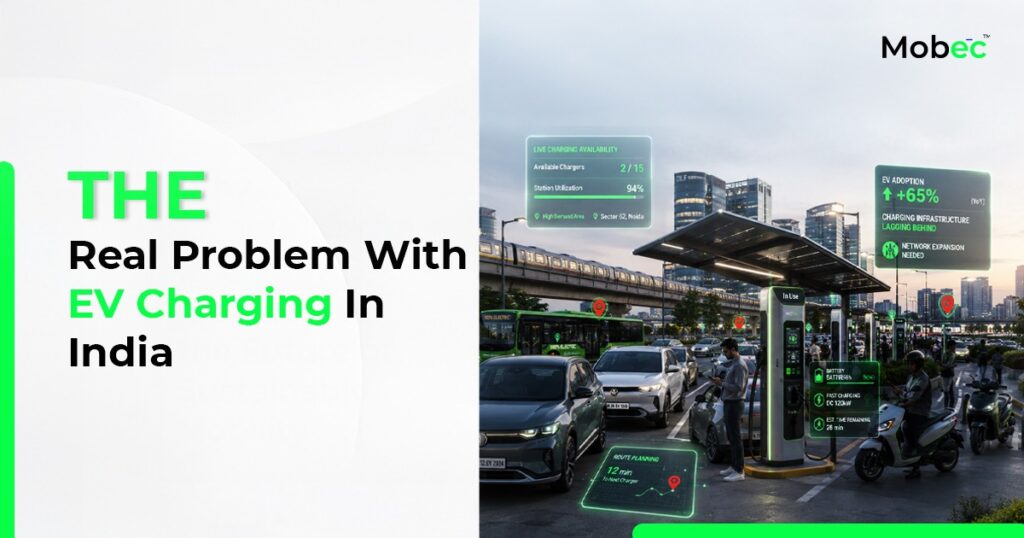
Delhi plans to develop more than 30,000 public charging points by 2030 as part of its wider EV infrastructure push.
But Delhi’s charging problem cannot be solved by simply drawing more dots on a map.
Many residents do not have dedicated parking. Fleet operators cannot afford to leave vehicles waiting at public charging stations for long periods. And a driver stranded with a low battery does not only need directions to the nearest charger – they need enough power to reach it.
This is why Delhi will need different EV charging formats working together.
Public fast-charging stations will remain essential. But home EV chargers, workplace charging, wall-mounted AC chargers, portable EV chargers and mobile EV charging solutions will matter just as much, particularly where fixed infrastructure is unavailable, impractical or too far away.
EV Charging Must Adapt to How Delhi Moves
Delhi does not have a single charging requirement.
A homeowner may need a compact wall-mounted EV charger. A hotel, office or commercial property may require charging within its parking area. A fleet operator may need dependable charging without disrupting vehicle schedules. A stranded driver may need charging support brought directly to the vehicle.
Our portfolio addresses these different use cases through wall-mounted AC chargers, portable EV chargers, movable DC chargers and EV rescue charging solutions.
These solutions extend charging beyond conventional public stations—to homes, offices, hotels, commercial parking spaces, fleet yards and roadside locations.
It reflects a simple but important shift in thinking: charging infrastructure should adapt to the way people and vehicles move, not the other way around.
Delhi Is Going Electric. Its Charging Network Must Keep Pace.
Delhi EV Policy 2.0 may make electric vehicles easier to buy. The bigger question is whether they will become equally easy to charge.
That means convenient residential EV charging, dependable infrastructure for workplaces and commercial properties, reliable uptime for electric fleets, and support when a vehicle runs out of power away from a fixed charging point.
Mobec’s fixed, portable and mobile EV charging solutions address these everyday realities of electric mobility.
Because Delhi’s EV transition does not end when more electric vehicles reach the road. It succeeds when those vehicles can keep moving.