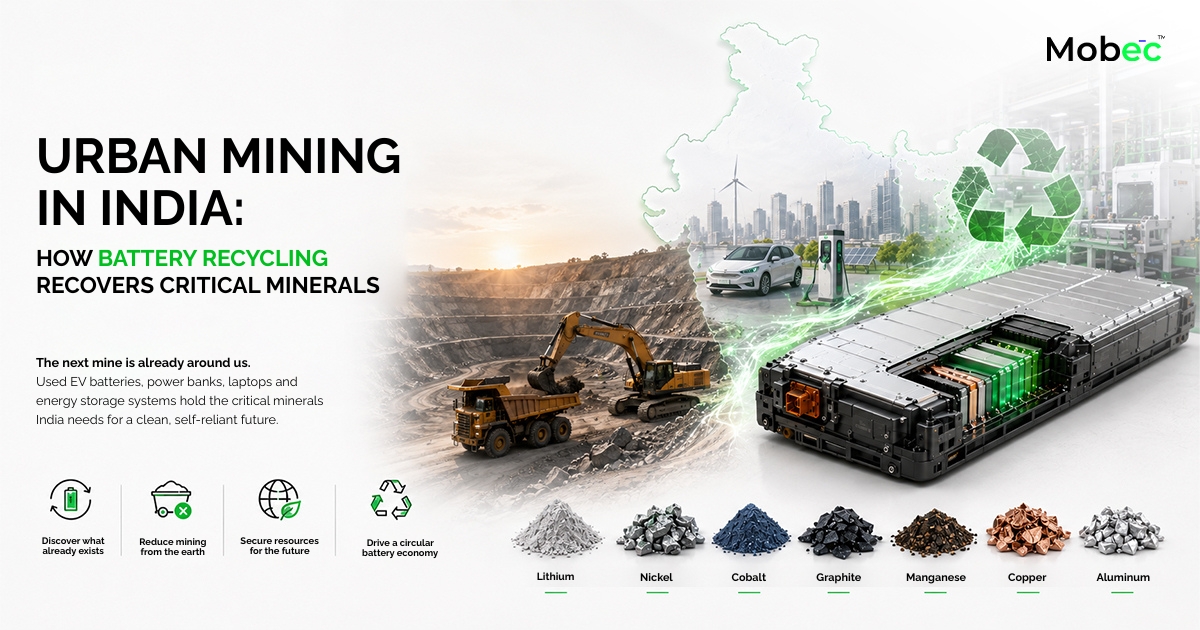
When we hear the word “mining,” we usually picture deep pits, heavy machinery and minerals being pulled out of the earth.
But some of the materials India needs most are not only underground. They are also sitting inside used EV batteries, old power banks, laptops, mobile phones and energy storage systems.
Recovering these materials from discarded products is known as urban mining. The idea is simple: before extracting more resources from the ground, recover what is already present in the products around us.
For India, where electric mobility and battery storage are growing rapidly, this could become an important source of lithium, nickel, cobalt, graphite, manganese, copper and aluminium.
What Exactly Is Urban Mining?
Urban mining means recovering valuable materials from products that have reached the end of their useful life.
A used lithium-ion battery may look like waste from the outside, but its internal materials do not lose all their value when the battery stops working. Depending on its chemistry, it may still contain lithium, nickel, cobalt, manganese, graphite, copper and aluminium.
These materials can be recovered through proper battery recycling and directed towards suitable industrial uses. That makes cities a kind of above-ground resource base, built from years of electronics, electric vehicles and battery-powered equipment.
Urban mining is not limited to batteries. It also covers electronic waste, old electrical equipment and manufacturing scrap. However, lithium-ion batteries are becoming especially important because their use is rising across EVs, consumer electronics and energy storage.
Why Does This Matter for India?
India’s clean-energy plans will require a growing supply of battery materials.
According to the International Energy Agency, the deployment of lithium-ion batteries across electric vehicles and battery storage increased more than sixfold between 2020 and 2025. As more batteries are manufactured, the demand for their raw materials also.
A large part of the global supply and processing of these materials is concentrated in a few countries. This leaves battery manufacturers exposed to price changes, trade restrictions and supply disruptions.
India will continue to need mining and imports, but recycling can provide an additional domestic source. The lithium already inside a used battery does not need to be discovered again. It needs to be collected, processed and recovered safely.
That is the practical value of urban mining in India. It keeps materials in circulation instead of allowing them to disappear into landfills, informal scrap markets or unsafe disposal channels.
How Are Materials Recovered From Used Batteries?
Battery recycling involves more than placing old batteries into a collection bin.
Used batteries first need to be collected, identified and sorted according to their chemistry and condition. They must then be discharged and handled carefully because damaged or partially charged lithium-ion batteries can pose safety risks.
After safe dismantling, batteries go through mechanical processing. Shredding breaks the cells into smaller fractions so that materials such as steel, aluminium, copper and plastics can be separated.
What remains includes a dark powder known as black mass. It contains a mixture of valuable battery materials that may include lithium, nickel, cobalt, manganese and graphite. Further processing is required to separate these materials and produce usable outputs.
Mobec works across the battery-recycling chain through the structured handling of end-of-life lithium-ion batteries, mechanical separation and black mass production. This gives used batteries a formal route towards material recovery instead of allowing them to enter unorganised waste streams.
Recycling Does More Than Reduce Waste
The value of battery recycling is often explained in terms of keeping hazardous waste away from landfills. That is important, but it is only part of the story.
Recycling also reduces the pressure to obtain every kilogram of battery material from a new mine. The IEA estimates that recycled energy-transition minerals such as lithium, nickel and cobalt generate, on average, around 80% fewer greenhouse-gas emissions than materials Recycling cannot replace mining completely, especially while battery demand is growing so quickly. But it can ensure that materials already extracted once are not used once and then lost.
India Is Beginning to Treat Recycling as a Resource Strategy
India’s policy direction is also changing.
Under the National Critical Mineral Mission, the government introduced a ₹1,500 crore incentive scheme for recovering critical minerals from secondary sources such as electronic waste and spent lithium-ion batteries.
Importantly, the scheme is not limited to collecting or shredding waste. It supports the actual recovery of minerals through processes such as black mass processing, chemical separation and metallurgical extraction. Recovered outputs must meet specified requirements for purity and recovery.
India’s Battery Waste Management Rules have also made producers responsible for ensuring that used batteries are collected and recycled through formal channels. This makes traceability, documentation and authorised recycling increasingly important for battery manufacturers, importers, EV businesses and fleet operators.
Giving Used Batteries a Responsible Next Step
Mobec’s work does not begin and end with shredding a used battery.
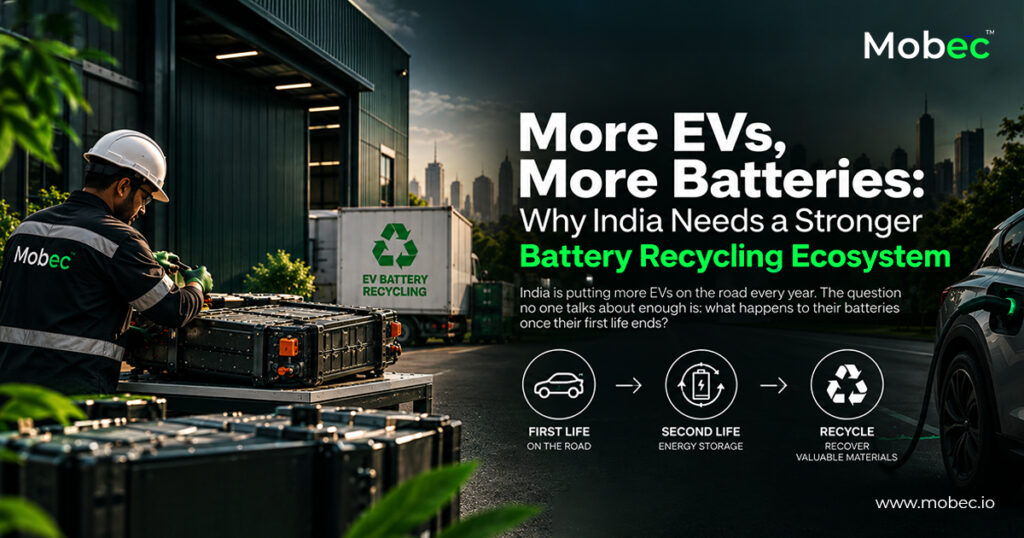
A battery that no longer performs well in an EV may still be suitable for refurbishment or a less demanding second-life application. If further use is not technically viable, it can then move into recycling.
At Mobec, end-of-life lithium-ion batteries are taken through a structured recycling process focused on safe handling and material recovery. The batteries are sorted, dismantled and mechanically processed to separate materials such as aluminium and copper. The remaining active material is converted into black mass, which contains recoverable materials including lithium, nickel, cobalt, manganese and graphite.
By recovering value from different parts of the battery, Mobec helps prevent useful materials from being lost through unsafe or informal disposal. This supports a more circular battery supply chain in which end-of-life batteries become a source of materials for future industrial use.
India’s Cities Are Becoming Material Reserves
Urban mining does not require us to dig beneath a city. It requires us to look more carefully at what the city throws away.
Every used EV battery or discarded electronic device contains materials that took energy, water and money to extract and process. Losing them after one lifecycle makes little economic or environmental sense.
With better collection, responsible battery recycling and reliable material recovery, India can turn part of its growing battery waste into a source of critical minerals.
At Mobec, the focus is to ensure that end-of-life batteries enter a responsible recycling process, where valuable materials can be recovered instead of being discarded. India’s next source of critical minerals may not be a newly discovered mine. It may be the batteries already in use today.